

The current news about the latest reports of the IPCC state that climate change is man-made and the rise of temperature with an average of 1.5C° will be reached 10 years earlier than estimated. Watching the news about the recent events like the flooding in Germany, the Netherlands and Belgium quite close to where I live and the devastating fires in Southern Europe and Algeria are worrisome.
This is not only a wake-up call, because our “house is on fire”, but an immediate call-to-action. Otherwise, it is likely, that we will observe more natural disasters across the globe for example more flooding, rising sea levels and fires like these days in Europe.
Personally, I feel scared, because my own little steps won’t help to reach the goal of keeping the temperatures below 1.5C°, but I strongly believe that we all together can and will have an impact. If you follow me on Instagram, you may have recognized that I volunteer as well and focus on living sustainably. And I’d like to share some inspiration to take immediate steps. If you plan to travel, you may use them as well, but you can use it in your daily life for sure.
Two years ago, before the current report was published, I was reflecting upon my own travel behaviour. Am I really travelling sustainably? Do I need to consider concepts of sufficiency to have a sustainable impact? After looking from different perspectives and learning more about sustainable travel and tourism, I really put my previous behaviour to the test. I had to admit that my travelling habits needed to change.

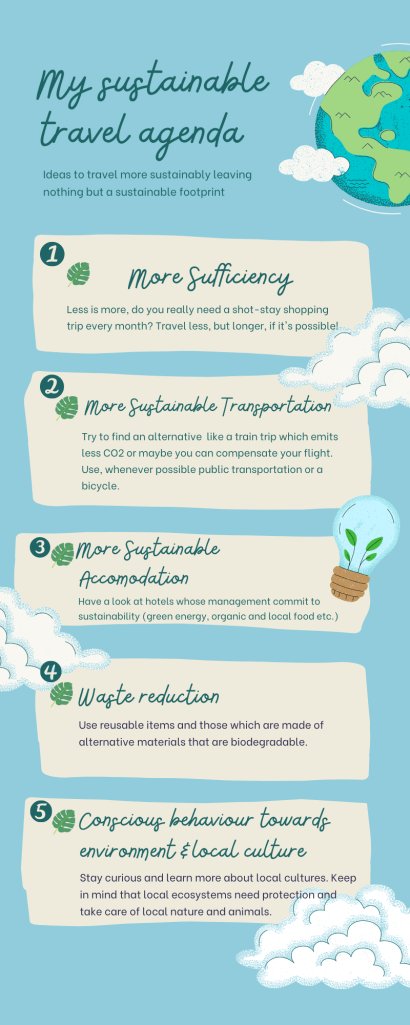
1. Sufficiency is briefly described as an improved consumption pattern, consuming less while acting more sustainable. In terms of sustainable travel, a longer stay is not only much better to learn about the local culture and create a more immersive experience, but it also reduces your CO2 footprint significantly, since transportation is the main contribution to that. But more on that later. Maybe you could even expand your vacation to a staycation and create a unique travel experience, deeper connections to people and their culture, and a change of your perspective if you are willing to learn and open up.
I had to ask myself the question if I needed to travel more often and especially travelling abroad which means that I need to travel by airplane. Therefore, I decided only one long-haul flight every two years but take more time to discover my destination and its people. Personally, the way to go is to travel consciously, not more often, but more intense.
2. Transportation is one big topic in travel industry, because it is “expected to account 5% of all man-made CO2” and it will even increase further, because tourism numbers will rise until 2030. The UNWTO calculated that the CO2-emmissions of cars will decrease, but the amount of CO2 that will be emitted by airplanes will even augment until 2030 to 665 million tons of CO2 (compared to 458 million tons in 2016).
So what can you do to minimize your personal CO2-footprint while exploring the beauty of the world?
Choose your transportation to the destination of your choice wisely:
🚅Take a train
🚘Use car-sharing
✈Compensate your flights
How to move from A to B onsite:
👣Walk around and discover those places that are not crowded
🚃 Use public transportation
🚲Take a bike – some countries are a paradise for cyclists and those who want to become one, and you also do some good for your health condition
Another crucial factor is, as mentioned, time, because your CO2-footprint is supposed to be very high while taking the plane for short-term trips. Therefore, in addition to limiting my travels by plane, I will try to travel as much as possible by train and public transport.
3. Accommodation may have a lesser CO2-footprint than transportation with approx. 6% compared to the total amount of all areas within tourism industry, but it also has an influence on the environment and the life of the employees who do everything to make sure you have a good experience in your favourite hotel. And believe me, there are plenty of good case practices across the globe.
So, what can you do to find a sustainable hotel or hotel?
My first advice is that you should check the homepage carefully. Here are some questions I ask myself before I choose to book.
How does the management commit to sustainability?
Is there a separate landing page for sustainability, or do they just mention it for the purpose of greenwashing to appear sustainable?
Do they support the Sustainable Development Goals?
Do they have further information about their sustainable best practices:
- Do they support local initiatives (women empowerment, community work, disabled people)?
- Do they use local food suppliers or do they grow their own vegetables?
- How do they use technology for cooling and heating? Are they net-zero?
- Are there any information about waste management (use of resources, avoid plastic, recycling, water management, because it’s a scarce resource in some parts of the world)
You can also check, if the hotel or hostel has a certification (Green Grey, GSTC etc.), but in my humble opinion not all hotels providing sustainable best practices have automatically an approval. I also experienced cases with a certification and plenty of plastic waste, so do some research and have fun while learning and enjoying great places while contributing to sustainability.
3. Waste is one great aspect to have a huge influence to reduce CO2-footprint, because plastic “originates from fossil fuel”. The more plastic you avoid and replace with biodegradable items, the better for our oceans and your health, because microplastic is a serious problem for animals and humans alike.
So, what can you do to improve your personal waste management, before your journey starts:
✅⠀Reusable coffee mug
✅⠀Reusable water bottle, check out the availability of tab water and refill stations
✅⠀Shower soap, shampoo and conditioner soap bars, yes, your hair will shine 🙂
✅⠀Sunscreen without nanoparticles
✅⠀Check out for reusable hygiene articles you may find in your local/online zero waste store

You can also improve your waste management onsite, because every plastic bottle you can avoid is a win. If no tab water and no refill station is close, just consider taking a small break in a cozy café and enjoy the moment. Sometimes a break is refreshing, and maybe a great conversation is already waiting for you.
If you still have some reusable items, please don’t throw them away, just use them as long as you can before you replace it with a sustainable alternative made from bamboo, wood or steel.
If you’re heading for a beach or places that maybe have a less improved waste management, lead by example: do a beach clean-up, collect some trash and avoid buying items with too many wrappings.
5. Last but not least you will have a sustainable impact with every conscious choice you take, for example:
Enjoy local and fresh food (no, I don’t understand people who complain that their favourite food from home is not served thousands of kilometres away), because this also decreases your CO2-footprint, if you don’t chase after your favourite dishes from home
Buy local products, because you support local businesses and show interest and respect towards their culture
This article was supposed to be published earlier, but after learning about the current IPCC report and some further reading about climate change and the negative impact it can have, if we don’t start to act now, I felt quite frustrated that this little article and the whole project of blogging wouldn’t have enough impact.
I hope you enjoyed reading and got inspired a bit. Feel free to add a comment and share!
 Conscious Travelista