This was an article I already published two years ago during my voluntary engagement, but it’s still something that you can have a closer look at, because it still applies to guide you to some sustainable gifting and inspiration.
Sustainable Giving During Christmas Time Christmas is a very special time of the year for a lot of people. We are more generous and buy our dear ones precious gifts, which will be nicely wrapped and opened within a festive surrounding.
But have you ever thought about where your gifts were produced and under what circumstances? Do you need to buy more and more, gifting the same stuff you have already gifted for the last couple of years?
If you are considering transitioning yourself to a more sustainable lifestyle, you can strongly support SDG 12 by promoting sustainable production and consumption. Here is a short guideline to easily choose gifts more sustainably and bring value to the life of the gifted person:
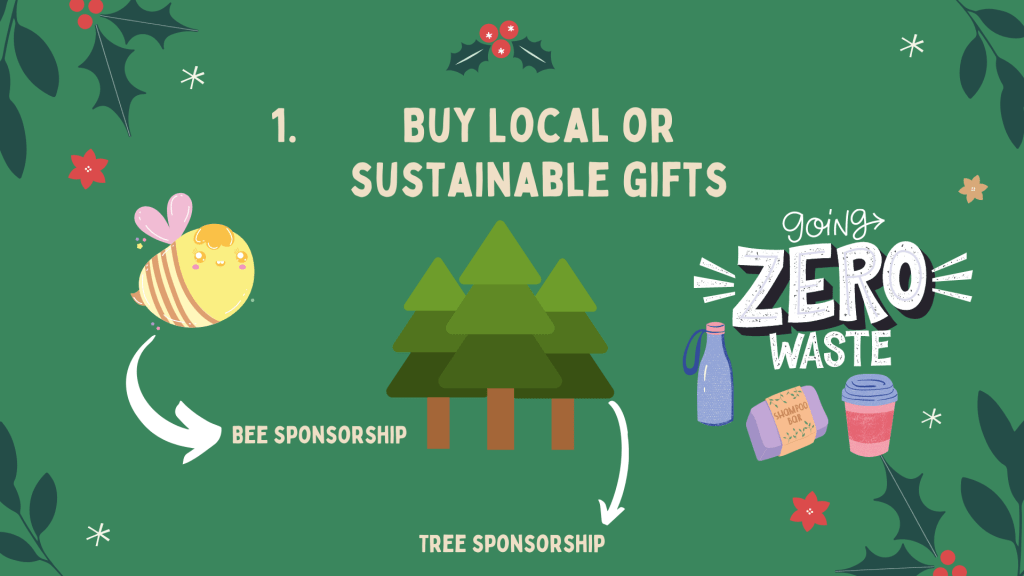
1. Buy Local Products or Sustainable Gifts Before you order or buy something, use this short guideline to find some useful sustainable gifts.
a) Check if the person you want to gift already has contact points with sustainable themes. How can you support them?
b) Check if there are already sustainable alternatives, like local products, upcycling, etc.
c) If you still have no idea, how about gently introducing the person to sustainable initiatives and projects?
Is it not easy? Yes, from locally produced sweets to workshops on how to save the bees and other sustainable projects, there are no limits to your creativity. This leads us to the second topic on how to create a sustainable gift, just in case you want to produce something on your own.
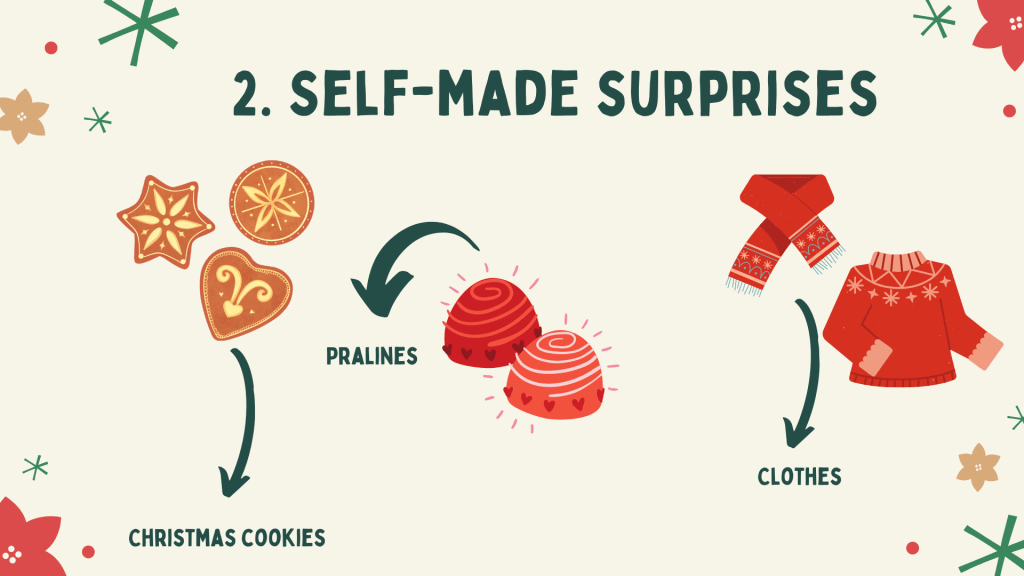
2. Self-Made Surprises d) Check if you can create, cook or bake something!
Some people love to enjoy sweets during the Christmas season. Why not take some time to bake cakes, crème caramel or create some chocolate cream? Whatever comes to mind, take some time, grab an old family recipe and make someone happy. If you are a creative mastermind, for those dressing for winter, you can also create something special like a scarf, gloves or other useful winter items, or even make board games to play at home. Self-made gifts are a special way to show that you appreciate someone because you spend some time making the gift yourself.
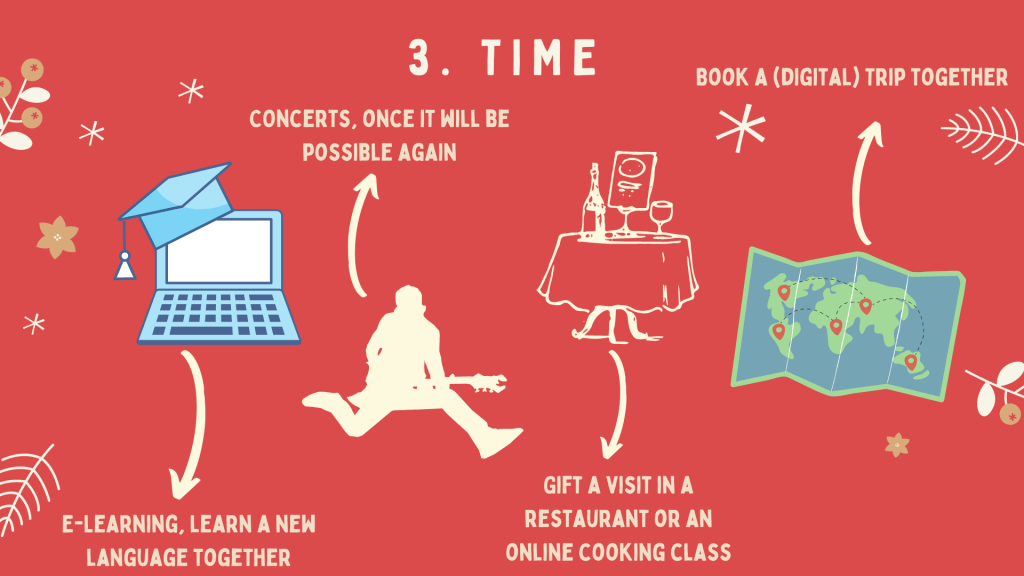
3. Volunteer Your Time Do you still have no idea?
e) Check if you can gift some time! Just in case you are running out of it during the Christmas rush, slow down, take a deep breath and gift some… time! Yes, you may buy a voucher for a nice restaurant you can enjoy with your friends and family or you can create the menu yourself. Go to a comedy show, a workshop or a concert together! Sometimes you do not realize that the year is already over and that you wanted to spend more time with your dear ones. It is a very nice occasion to slow yourself down and show your family and friends that you truly care about them. We hope that you got some inspiration and ideas for your upcoming Christmas. Enjoy the season and have a very merry and sustainable Christmas time!
Credits: Created and Published by Stephi@Whatareyoustillwaitingfor.SpaceIllustrated by Oguz@Whatareyoustillwaitingfor.SpaceProofread by Greg@Whatareyoustillwaitingfor.SpaceProofread and Edited by Lee@Whatareyoustillwaitingfor.SpaceSupported and Funded by Advertising-Free Online Sales of What Are You Still Waiting For? Publications and Affiliation with WordPressPaleBlue.WhatAreYouStillWaitingFor.Space
The current news about the latest reports of the IPCC state that climate change is man-made and the rise of temperature with an average of 1.5C° will be reached 10 years earlier than estimated. Watching the news about the recent events like the flooding in Germany, the Netherlands and Belgium quite close to where I live and the devastating fires in Southern Europe and Algeria are worrisome.
This is not only a wake-up call, because our “house is on fire”, but an immediate call-to-action. Otherwise, it is likely, that we will observe more natural disasters across the globe for example more flooding, rising sea levels and fires like these days in Europe.
Personally, I feel scared, because my own little steps won’t help to reach the goal of keeping the temperatures below 1.5C°, but I strongly believe that we all together can and will have an impact. If you follow me on Instagram, you may have recognized that I volunteer as well and focus on living sustainably. And I’d like to share some inspiration to take immediate steps. If you plan to travel, you may use them as well, but you can use it in your daily life for sure. Two years ago, before the current report was published, I was reflecting upon my own travel behaviour. Am I really travelling sustainably? Do I need to consider concepts of sufficiency to have a sustainable impact? After looking from different perspectives and learning more about sustainable travel and tourism, I really put my previous behaviour to the test. I had to admit that my travelling habits needed to change.
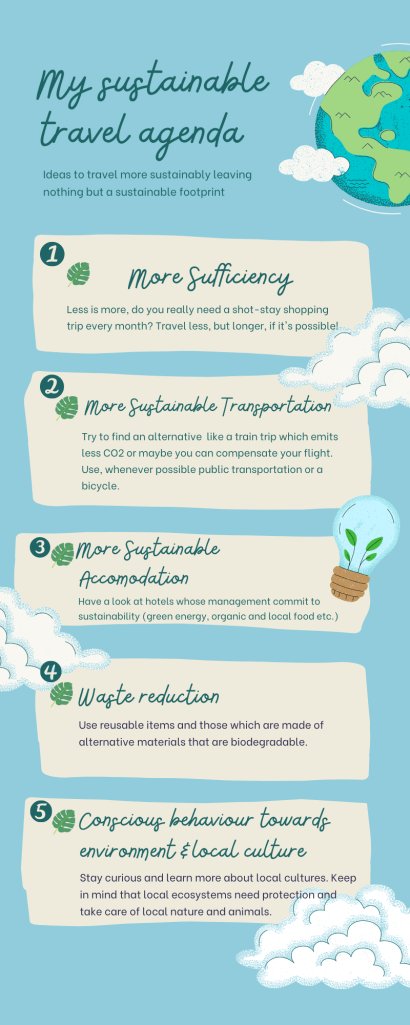
1. Sufficiency is briefly described as an improved consumption pattern, consuming less while acting more sustainable. In terms of sustainable travel, a longer stay is not only much better to learn about the local culture and create a more immersive experience, but it also reduces your CO2 footprint significantly, since transportation is the main contribution to that. But more on that later. Maybe you could even expand your vacation to a staycation and create a unique travel experience, deeper connections to people and their culture, and a change of your perspective if you are willing to learn and open up. I had to ask myself the question if I needed to travel more often and especially travelling abroad which means that I need to travel by airplane. Therefore, I decided only one long-haul flight every two years but take more time to discover my destination and its people. Personally, the way to go is to travel consciously, not more often, but more intense.
2. Transportation is one big topic in travel industry, because it is “expected to account 5% of all man-made CO2” and it will even increase further, because tourism numbers will rise until 2030. The UNWTO calculated that the CO2-emmissions of cars will decrease, but the amount of CO2 that will be emitted by airplanes will even augment until 2030 to 665 million tons of CO2 (compared to 458 million tons in 2016). So what can you do to minimize your personal CO2-footprint while exploring the beauty of the world? Choose your transportation to the destination of your choice wisely:
🚅Take a train 🚘Use car-sharing ✈Compensate your flights
How to move from A to B onsite:
👣Walk around and discover those places that are not crowded 🚃 Use public transportation 🚲Take a bike – some countries are a paradise for cyclists and those who want to become one, and you also do some good for your health condition
Another crucial factor is, as mentioned, time, because your CO2-footprint is supposed to be very high while taking the plane for short-term trips. Therefore, in addition to limiting my travels by plane, I will try to travel as much as possible by train and public transport.
3. Accommodation may have a lesser CO2-footprint than transportation with approx. 6% compared to the total amount of all areas within tourism industry, but it also has an influence on the environment and the life of the employees who do everything to make sure you have a good experience in your favourite hotel. And believe me, there are plenty of good case practices across the globe. So, what can you do to find a sustainable hotel or hotel? My first advice is that you should check the homepage carefully. Here are some questions I ask myself before I choose to book.
How does the management commit to sustainability?
Is there a separate landing page for sustainability, or do they just mention it for the purpose of greenwashing to appear sustainable?
Do they support the Sustainable Development Goals?
Do they have further information about their sustainable best practices:
Do they support local initiatives (women empowerment, community work, disabled people)?
Do they use local food suppliers or do they grow their own vegetables?
How do they use technology for cooling and heating? Are they net-zero?
Are there any information about waste management (use of resources, avoid plastic, recycling, water management, because it’s a scarce resource in some parts of the world)
You can also check, if the hotel or hostel has a certification (Green Grey, GSTC etc.), but in my humble opinion not all hotels providing sustainable best practices have automatically an approval. I also experienced cases with a certification and plenty of plastic waste, so do some research and have fun while learning and enjoying great places while contributing to sustainability.
3. Waste is one great aspect to have a huge influence to reduce CO2-footprint, because plastic “originates from fossil fuel”. The more plastic you avoid and replace with biodegradable items, the better for our oceans and your health, because microplastic is a serious problem for animals and humans alike.
So, what can you do to improve your personal waste management, before your journey starts:
✅⠀Reusable coffee mug
✅⠀Reusable water bottle, check out the availability of tab water and refill stations
✅⠀Shower soap, shampoo and conditioner soap bars, yes, your hair will shine 🙂
✅⠀Sunscreen without nanoparticles
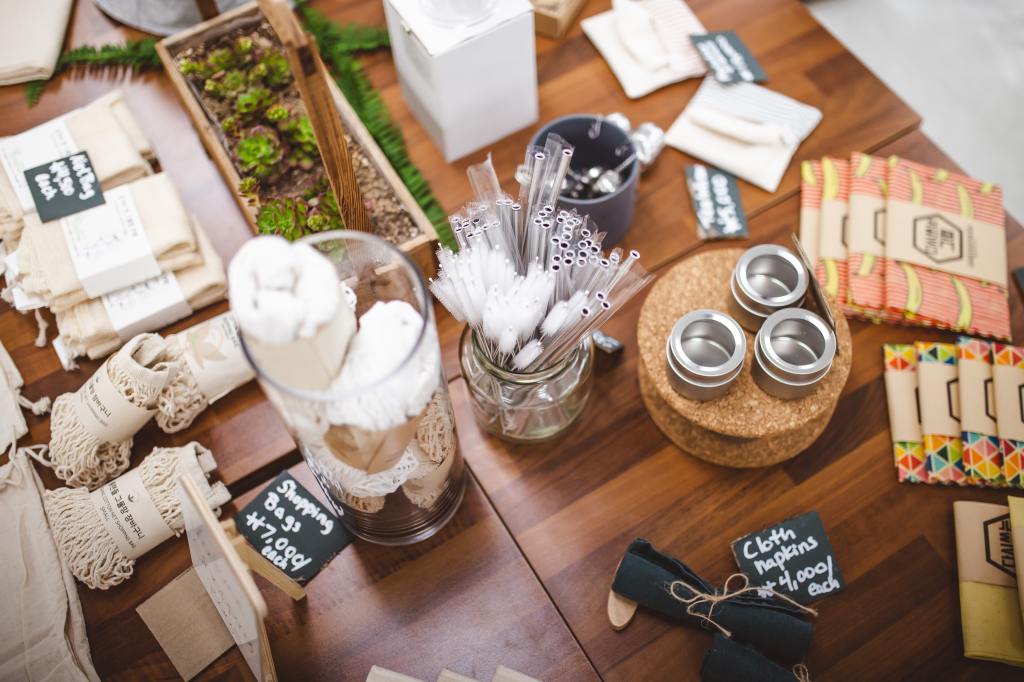
✅⠀Check out for reusable hygiene articles you may find in your local/online zero waste store
You can also improve your waste management onsite, because every plastic bottle you can avoid is a win. If no tab water and no refill station is close, just consider taking a small break in a cozy café and enjoy the moment. Sometimes a break is refreshing, and maybe a great conversation is already waiting for you. If you still have some reusable items, please don’t throw them away, just use them as long as you can before you replace it with a sustainable alternative made from bamboo, wood or steel. If you’re heading for a beach or places that maybe have a less improved waste management, lead by example: do a beach clean-up, collect some trash and avoid buying items with too many wrappings.
5. Last but not least you will have a sustainable impact with every conscious choice you take, for example:
Enjoy local and fresh food (no, I don’t understand people who complain that their favourite food from home is not served thousands of kilometres away), because this also decreases your CO2-footprint, if you don’t chase after your favourite dishes from home
Buy local products, because you support local businesses and show interest and respect towards their culture
This article was supposed to be published earlier, but after learning about the current IPCC report and some further reading about climate change and the negative impact it can have, if we don’t start to act now, I felt quite frustrated that this little article and the whole project of blogging wouldn’t have enough impact.
I hope you enjoyed reading and got inspired a bit. Feel free to add a comment and share!
Here’s an article I wrote for one of my volunteering engagements and I would love to share this one on my blog as well, because it reflects my personal journey towards zero waste.
This month I would like to showcase how zero-waste shops can help you to reduce your amount of waste and work towards a more sustainable lifestyle.
You might have already heard about the concept of zero waste, but let’s have a small recap of its definition:
“Zero Waste is the conservation of all resources by means of responsible production, consumption, reuse and recovery of products, packaging and materials without burning, and with no discharges to land, water, or air that threaten the environment or human health ” [1].
Another important topic is circular economy which is closely related to this matter and aims to produce, consume, reuse and recycle products in a way that new products can be created without producing any waste [2]. Circular economy is focusing on production patterns and it requires innovative solutions to face the climate crisis, because for every product energy is needed in the production process. It is important to keep that in mind while making our choices towards more sustainability and our own journey towards zero waste.
This, of course, leads us to the Sustainable Development Goal No. 12 which states:
“Ensure sustainable consumption and production patterns” and especially the subcategory 12.5
“By 2030, substantially reduce waste generation through prevention, reduction, recycling and reuse”
With a closer look at your consumption patterns you can ensure to make SDG 12 happen!
Where exactly does one start?
Of course, this is quite a tough topic and when I started my personal journey towards zero waste, there weren’t many zero-waste stores around. Therefore I started with very small steps . The first ones I did were to avoid plastic and the use of alternatives like bamboo or paper packaging.
After a while the first zero waste stores opened nearby and this was a good opportunity to discover new products. But what exactly makes a difference to usual stores?
Zero-waste stores offer a variety of products from organic fresh fruits and vegetables to natural cosmetics and day-to-day products for your home without any packaging. Some products, especially daily care products, still need some wrapping, but usually recycled paper or other materials which can easily be recycled are used.
My starting point was plastic. Plastic is a very versatile group of materials and in today’s society, life without plastic is unimaginable. But unfortunately only very little of it is recycled, it is simply disposed of into the environment. This has a devastating impact on nature.
So, after a brief reflection on where I produce plastic waste, I decided to start to go towards zero waste in my bathroom.
A product I commonly used in my daily routine was shower gel, which comes in plastic bottles. Therefore I decided to switch to soap which doesn’t necessarily need packaging or only some paper to wrap it in. While familiarising myself with the topic, I became aware of solid shampoo and conditioner, which I incorporated into my hygiene routine. I even switched to solid deodorant. Most of these products I discovered in nearby zero-waste stores. Quite a few of these products are produced by local businesses, which is in line with our above mentioned SDG.
A calculation estimates the amount of waste I was able to reduce per year in my bathroom by just switching to solid soap and shampoo:
ProductBottles per Year
Shower Gel
12
Shampoo
12
Conditioner
6
Total amount
30
It doesn’t seem to be much, but imagine myriads of people doing so. Still, the journey is ongoing and I am still reflecting and reviewing my habits to make further improvements. There are many other items I use like a wooden brush or reusable make-up remover pads, but it is difficult to estimate how much waste I reduced by using them, so I did not include them in my calculations.
There are still many other occasions to make a sustainable choice when you go out and buy new products. If you have a zero-waste store close to you, have a look. By discovering their products you might identify in which area of your life you would like to reduce waste. In my experience these shops offer very good service and are more than willing to assist you in your decision-making process or answer any questions.
Thanks to these shops and their range of products you come across a lot of ideas which will inspire you to new ways of reducing waste.
Another easy starting point is to avoid unnecessary plastic packaging for vegetables and fruits, because they naturally come with protective coating. Do you really want to buy a cucumber which is hugging its plastic blanket? Exactly, try to avoid it! Sometimes glass offers a good alternative and you can find many products like fresh juices, yoghurt or jams without a plastic packaging, but in glasses and glass bottles.
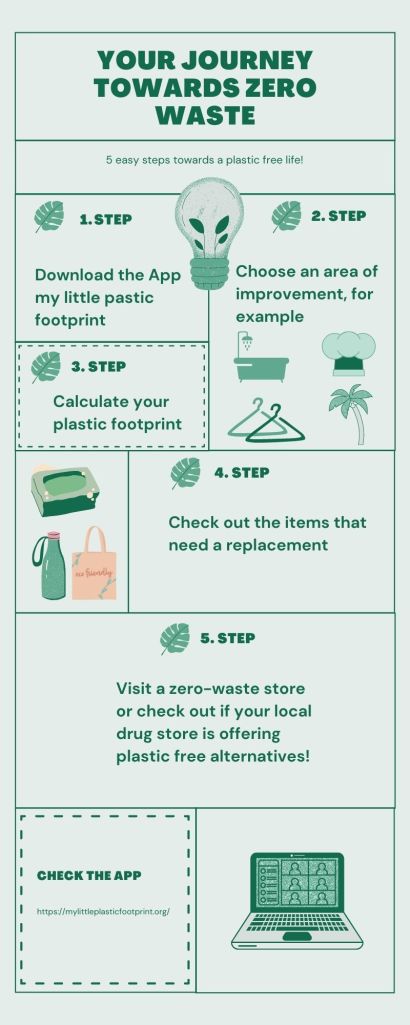
There is a very useful app that helps you to analyse your plastic footprint.
It helps you to identify your footprint and raises awareness in which areas you can find alternative products.
Your journey towards zero-waste
Discovering new products can be fun and no one said that zero waste has to be a serious topic!
The opinions expressed by the author and those providing comments are theirs alone and do not necessarily reflect the views of AAI (AIESEC Alumni International).
Just a few words to introduce this article which I wrote during one of my voluntary engagements in the past year! It was inspired by a collaboration with a business incubator TheSpace for which I volunteer as coach to support a sustainable travel agency 2Morrow Trip! Enjoy reading!
SARS-CoV-2 and the resulting global lockdown and the travel restrictions are a massive shock to the tourism industry in every nation. It is estimated that tourism arrivals could fall by 20%-30% compared to 2019. Tourism is among the industries that are hit the hardest by the global pandemic [1].
But what exactly can be done in these tough times? This question was asked among our community members in Africa and Europe because we all are passionate travellers and explorers, who are now confined to one location.
Therefore, we started a video project that showcases our whereabouts with our unique perspective, so together we can break out of our daily routine. It is also a chance to develop myself and step out of my comfort zone. Usually, I do not produce videos or stand comfortably in front of a camera.
The idea was to support a friend with his travel startup, but it developed into a video project that is meant to connect people, give them some hope and invite them to travel digitally during the lockdown.
While working on this voluntary project, many thoughts and ideas came up, such as how the current situation could lead to more sustainable tourism after the crisis.
As stated in Sustainable Development Goal No. 12: “Sustainable Consumption and Production Patterns: Tourism should develop and implement tools to monitor sustainable development impacts for sustainable tourism that create jobs and promote local culture and products [2].”
But with many jobs at risk and global travel restrictions current, support of this goal is difficult. What are we observing now and what could be applied to tourism after the crisis?
Economically:
In all our videos, we see empty places. Some of them are usually full of tourists, others are more rural areas where we can see a quiet and peaceful landscape. Do you ask yourself about the influence mass tourism has on local people and the environment? If you remember your last trip to one of your favourite places, you realized that it is also a popular spot for others. How did it influence your experience? And, did you ever think about the locals who live in such a tourist hot spot? In the time before SARS-CoV-2 we do remember many discussions about mass tourism in popular hot spots and here we see a chance to introduce you to places that are still unknown, but beautiful and rich in culture. Rural destinations, especially, are struggling these days, but raising awareness about them offers a chance for them to be discovered and to attract new visitors after the crisis [3]. In these areas, you will not find a mature infrastructure yet, but starting from nothing offers a fantastic opportunity to build a sustainable infrastructure from the very beginning. This could be a chance, especially for smaller hotels to strongly commit themselves to sustainability to attract new travellers. In times of crisis, there is a rising awareness about sustainability and our interdependence with nature as well. Because of the way many people are losing their jobs now, this might result in a decision-making process that considers the different dimensions of sustainability. It puts us in a position to thoroughly reflect upon this situation. One way or another, the reader must cope with this challenge her- or himself. Consequently, we should also contemplate our travel behaviour [4].
Ecologically:
In terms of the influence tourism has on nature, it is often argued that external costs like CO2 are not considered in the pricing of tourism services, for example, flight tickets [5]. We currently observe a decline in CO2 and other greenhouse gases [6]. The emissions in China, for example, fell 25% at the beginning of the year, which resulted in better air quality in their cities [7]. Besides a reduction in CO2 emissions, it is also observed that fewer vehicles on the road cause less roadkill in the UK [8]. What can we learn from these findings? It is argued that nature should be part of the solution [9]. We may use these learnings to harmonize our actions towards nature and support the SDGs as well. This may result in a more sustainable lifestyle, not just for consumers but also producers and suppliers.
Socially:
Travelling – most of us love discovering the world to get connected with others, learning about diverse cultures and yourself, while being lost in an unknown place. Whatever our reasons are, we are social beings, and nowadays we have to physically distance ourselves. Our video project cannot break this barrier, but it will give you the feeling of staying connected around the globe with like-minded individuals. We should not forget that we are in a comparable situation. We want to keep our hearts and heads up until we can see each other again. We can look forward with the knowledge that our curiosity and an open mindset are the keys to recreate the world more sustainably.
One can conclude that with our project, we would like to engage, commit and be part of the solution for more sustainable tourism.
Do you want to #hopinonline with us? Please reach out too for further information on how to engage in our video project.
For more information, please also read the article from my friend, Krisztina Kapuvári.
A topic I truly care about is sustainable travelling, not only because I got a travel bug from an early age, but because I want to preserve the possibility to explore the world for future generations.At the end of April I did my first AlumniTalk about that topic and I would like to showcase some benefits which a more sustainable travel behaviour is offering to you.The reason why we should care is obvious, so I’ll skip this part for the moment.
• Actions against climate change: Your decision is making a change! Instead of taking a short haul flight, why don’t you take the train? It sometimes provides some unexpected surprises and gives you some time to relax, work or slowdown. Even if you take the decision to book a flight, you may check the possibility of a direct flight and you can also choose to do a CO2 compensation. It is offered by different companies which invest your money in planting trees or help people to use and implement green technology.
• Enjoy travelling in different and surprising ways and change your perspective: It’s strongly connected to a change of your perspective when avoiding the crowds, talk to people and eat some food you never experienced before. You may discover new places and hidden pearls, meet new friends and collect some unforgettable moments.
• Commitment to the Sustainable Development Goals: You can actively support the agenda 2030 and help to act in a more sustainable way! Demanding sustainable goods and services helps to create more jobs in sustainable tourism and a wider range of new sustainable services.
• Consciousness and learning: It may take some time to plan your trip or to prepare a bit, but you may understand the local culture maybe a bit better than others. Onsite your destination of choice you can also visit local markets or take some time in a museum to learn about local culture or different ways concepts of living. Whatever you expect and you want to learn from your journey, it will be a fantastic experience or a surprising insight of your own travel behaviour (for example: have you ever asked yourself how much CO2 you produce during a journey?)
What are your sustainable travel experiences?
Thank you very much for reading and happy travelling.




 Conscious Travelista